Case study · Manufacturing
Isotra: from occasional AI trials to everyday work.
A Czech manufacturer of shading systems. Around 120 people worked through workshops on their own tasks. About six months later, 78% of respondents used AI several times a week or daily. Before the programme it was 17%.
Survey in December 2025, 23 complete responses. People rated the pre-programme state in retrospect.
- Client
- ISOTRA a.s., over 500 employees
- Scope
- 8 days of 8 hours, around 120 people
- Period
- April 2025 to April 2026
- Status
- Programme completed and measured
On this page
Starting point
Most people hardly used AI at work
Isotra makes shading systems and pergolas. Leadership wanted to know where AI made sense in the company, which teams to start with and which processes came first. Day-to-day work was unchanged: emails, quotes, complaints, documents and spreadsheets.
65%
Did not use AI
Not at all or only rarely, as rated by participants in retrospect.
9%
Worked with AI daily
Regular use was the exception, not the normal way of working.
2.8 of 5
Understanding of what AI can do
Average self-rating of how AI could be used in their own work.
Approach
From leadership to teams and back to leadership
The programme corresponds to today’s Audit and Adoption phases. System integration was not in scope.
- Spring 2025
AuditStrategy session with leadership
We started with the leadership team. We set out where the company wanted to go with AI and chose pilot teams and the processes leadership saw as priorities.
- April to July 2025
AdoptionWorkshops by department, 82 people
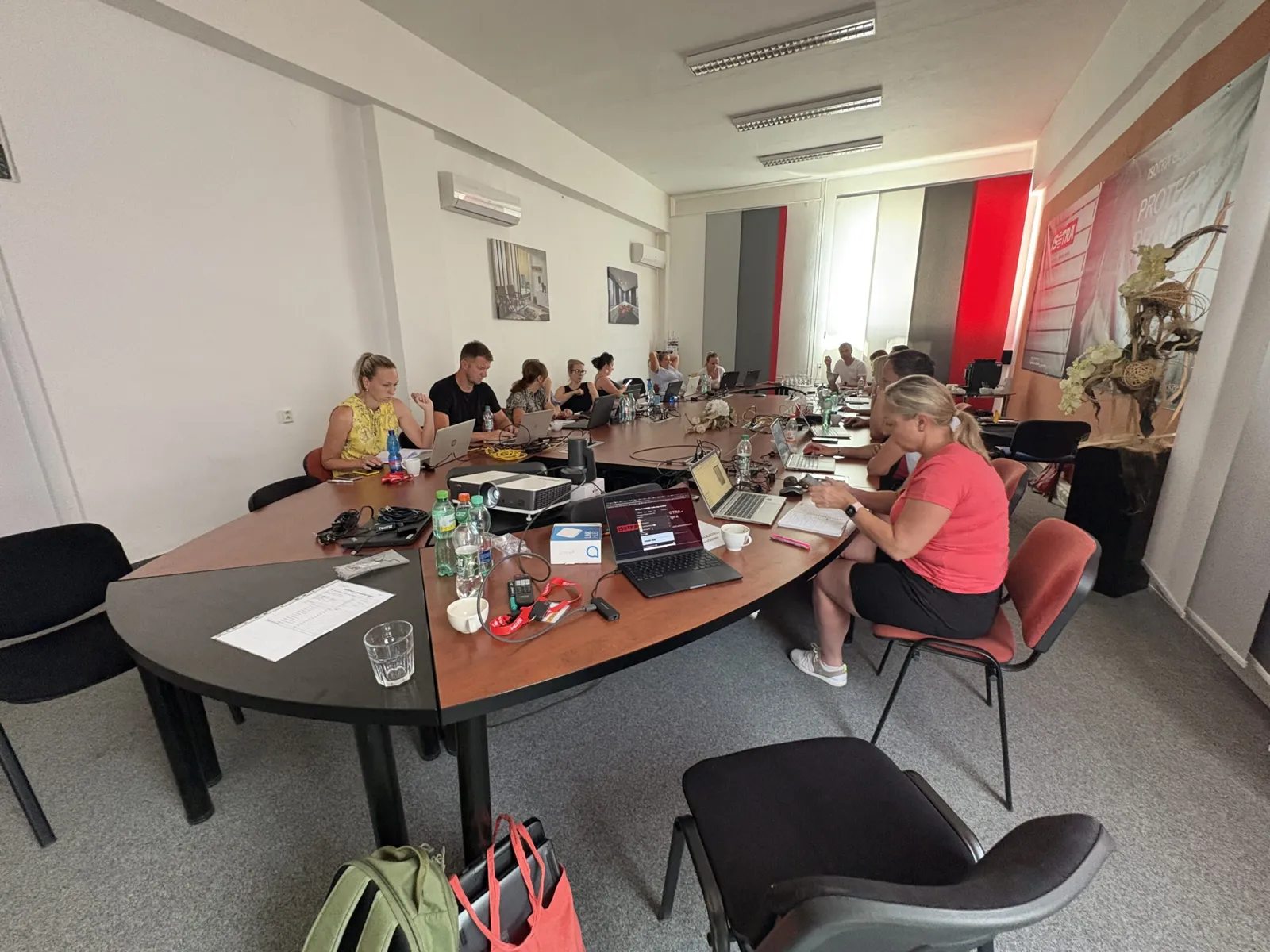
We used the flipped classroom method. People did not sit through theory. They brought their daily tasks, worked out how to solve them with AI and tried the methods straight away. The work took place at the company’s headquarters.
- During the workshops
OutputA map of routines and priorities
The tasks people named themselves became a map of routines. It showed what was worth automating and in what order. With each team we picked the simplest tasks to use immediately.
- 5 to 9 December 2025
MeasurementSurvey five to eight months after the workshops
Participants reported how often they used AI before the programme and how often they use it now, how much time it saves them and for what kind of work. We received 24 responses.
- March and April 2026
AdoptionLeadership approved two more days
At a leadership meeting the company approved two more on-site workshop days for the remaining interested staff. Around 35 people, mostly from sales and purchasing, took part on 27 and 28 April 2026. That brought the total to around 120.
Results
Regular use became the norm
The share of people using AI several times a week or daily rose from 17% to 78%. The share using it not at all or only rarely fell from 65% to 13%.
| Frequency | Before the programme | After the programme |
|---|---|---|
| Not at all or rarely | ||
| Less than once a week | ||
| About once a week | ||
| Several times a week | ||
| Almost every day | ||
| Several times a week or daily | 17% (4 of 23) | 78% (18 of 23) |
Figures in brackets are numbers of people. One response on the pre-programme state ticked two options; we count it in the lower one. Counted the other way, the starting point would be 22%.
| Saving per week | Share of responses |
|---|---|
| 0 minutes | |
| 1 to 15 minutes | |
| 16 to 30 minutes | |
| 31 to 60 minutes |
83% of people (19 of 23) reported some saving. The survey asked for ranges, so the average is only indicative: about 20 minutes a week using range midpoints, and 13 to 28 minutes between the lower and upper bounds.
What people use AI for
- Emails and communication: 16 of 23 people
- Creative work and copy: 6 of 23
- Documents and templates: 5 of 23
- Data analysis and reporting: 3 of 23
- Preparing presentations: 1 of 23
Examples people gave themselves
- Clearer complaint reports and emails to customers
- Finding details in long PDFs, spreadsheets and technical documents
- Looking up standards when introducing new checks in the paint shop
- Choosing and comparing materials for machine parts
- Material for an official application, translations, preparing for meetings
The collaboration is valuable and professional. Employees rated the training positively, and we appreciate how current it is and the practical examples.
All the figures
Every figure with its source
The stronger and the weaker results from the same survey. Unless stated otherwise, figures come from 23 complete responses.
| Measure | Value | Source and note |
|---|---|---|
| Use several times a week or daily | 17% → 78% | Survey, 4 and 18 of 23 people |
| Use almost every day | 9% → 26% | Survey, 2 and 6 of 23 people |
| Not at all or rarely | 65% → 13% | Survey, 15 and 3 of 23 people |
| Understanding of AI in their own work | 2.8 → 4.0 of 5 | Average self-rating |
| At least one new tool every week | 83% | 19 of 23, including 6 people with 2 to 3 tools |
| Estimated time saving | 83% of people | 19 of 23 reported more than 0 minutes a week |
| Average saving, range midpoints | about 20 min a week | Range of 13 to 28 minutes |
| Useful for their own work | 65% | 15 of 23 rated it 4 or 5 of 5 |
| “I can do my work to a higher standard” | 39% | 9 of 23 agree, 9 neutral, 5 tend to disagree |
| Satisfaction with the trainer | 100% | 24 of 24 rated 4 or 5 of 5, half of them 5 |
| Length and pace were right | 83% | 20 of 24, too long for 3, too short for 1 |
| Interest in follow-up support | 50% | 3 yes, 9 maybe, 12 not now, from 24 responses |
| People in the programme | over 80, then about 35 | 82 people by December 2025, about 35 in April 2026 |
| Programme scope | 8 days, 64 hours | Eight days of 8 hours, April 2025 to April 2026 |
Capacity
What this means in hours
This is a model, not a measured saving. It takes the sample average and applies it to all 82 people who had completed the programme by December 2025.
Model of released capacity
82 people × 20 minutes a week × 46 working weeks ≈ 1,250 hours a year
The lower and upper bounds give 800 to 1,750 hours. Released capacity is not an accounting saving. It becomes money only when the company handles more volume, avoids hiring or reduces a specific cost. Work it out for your own process
How we measured
What the figures don’t say
Method
- Online survey, 5 to 9 December 2025, five to eight months after the workshops.
- 24 responses, 23 of them complete. That is about a quarter of the 82 people who had completed the programme.
- People rated the before and after states in the same survey. The before state is a retrospective estimate, not a measurement taken before the programme.
- The April 2026 groups are not included.
Limits
- Responses were voluntary. People with less interest in AI may be under-represented.
- These are self-assessments, not tool logs. We did not measure actual usage from systems.
- There is no control group. AI tools also improved over the period, which may have played a part.
- The time saving is the participants’ estimate, not measured time per task.
What we learned
Workshops change habits. Further steps change operations.
Isotra shows what working on your own tasks can do: people start using AI and keep using it months later. It also shows the limit. AI helps most with emails and copy. 39% of people confirm a higher standard of work, and four people saved no time at all. One person wrote that they cannot yet use AI in their job.
Audit
We now agree the baseline and measures before the start, not in retrospect.Adoption
We run workshops around processes chosen by leadership. We measure use before and after, from system records where possible.Integration
We turn routines from the map into connected systems and automation. That is how change moves from the individual into operations.